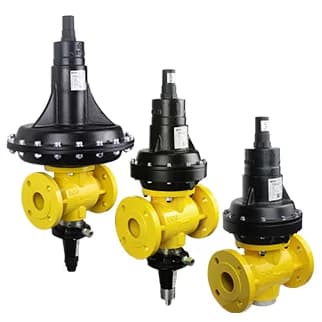
Gas Pressure Regulators
F Series – Gas Pressure Regulators, Flanged Connection PS: 25 bar
Direct-acting, spring-loaded regulation with flanged connections, rated PS 25 bar.

Product view
R Series – Gas Pressure Regulator, Threaded Connection PS: 16 bar
The R Series is a direct-acting, spring-loaded gas pressure regulator designed and manufactured according to the 2014/68/EU Pressure Equipment Directive, EN 334 and EN 14382. A fail-open design with a balanced valve or ratio system, it holds outlet pressure across a wide regulation range and seals fully at zero flow, making it the threaded-connection workhorse for service lines and industrial installations up to 16 bar.
Confirmed against your duty at order stage — send us the operating conditions and we will verify the selection.
| Parameter | Value |
|---|---|
| Design pressure (PS) | 16 bar |
| Connections | Threaded BSP / NPT |
| Operating principle | Direct-acting, spring-loaded, fail open |
| Design standards | EN 334, EN 14382 |
| Compliance | 2014/68/EU Pressure Equipment Directive |
| Safety options | Slam-shut (min/max), internal relief valve |
| Temperature range | −20 °C to +60 °C |
| Suitable media | Natural gas, LPG, air, non-corrosive gases |
Datasheets, installation manuals, drawings and conformity declarations.
Documentation for R Series – Gas Pressure Regulator, Threaded Connection PS: 16 bar is issued on request against the confirmed specification. Request the document pack.
Gas Pressure Regulators
Direct-acting, spring-loaded regulation with flanged connections, rated PS 25 bar.
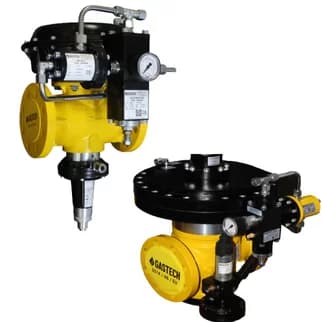
Gas Pressure Regulators
Tight accuracy at high capacity, using the gas stream itself as the control amplifier.
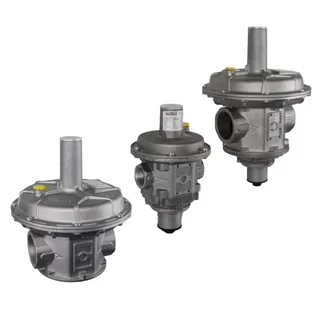
Gas Pressure Regulators
Final-stage reduction to appliance pressure, sized for the millibar end of the network.
The more detail you give on the duty, the more precise the proposal comes back.
What engineers most often ask when specifying this equipment.
Outdoors, the bonnet vent can usually discharge to atmosphere directly. Indoors, fit the vent-limiter option or pipe the vent to a safe external location as required by local code.